Council action delivers clearer picture and progress supporting young people
A coordinated effort led by Dudley Council is delivering early progress in tackling the number of young people not in education, employment or training (NEET), while significantly improving understanding of the issue across the borough.
In March 2025, data published by the Department for Education showed Dudley had the highest levels of young people recorded as NEET or “Not Known”, standing at 21.5 per cent. The figures, covering data up to December 2024, highlighted a particularly high proportion of young people whose circumstances were unknown.
Since then, Dudley Borough Council has acted quickly to strengthen tracking, outreach and partnership working, helping build a far clearer picture of the situation and ensuring more young people receive the right support at the right time.
Funding secured through the Mayor’s Youth Trailblazer Auto-Enrolment Pilot has supported the introduction of a new tracking system, with the West Midlands Combined Authority covering costs.
Teams across the council – including economic development, children’s services and services supporting carers and young people preparing for adulthood – formed a dedicated taskforce under a new operating model to focus on the challenge.
A targeted programme of analysis and outreach has also been carried out to reduce the number of young people recorded as “Not Known”.
Since 8 February, a team of six staff from Connexions and two from the Dudley council’s Economic Regeneration service have visited more than 600 homes across the borough, including evenings and weekends, reconnecting with young people and their families.
This work has provided valuable insight into the experiences of young people locally and delivered a much clearer picture of the issue. The proportion of “Not Known” young people has fallen from 21.5 per cent to 9.02 per cent.
As this clearer understanding has emerged, the number of young people recorded as NEET has risen slightly to 3.52 per cent. The most recent national figure is 3.4 per cent, meaning Dudley is now close to national performance and showing that the overall position is far more stable than first indicated.
Alongside this work, Dudley Borough Council has strengthened collaboration with partners, providers and stakeholders to develop a shared response to the challenges facing some young people.
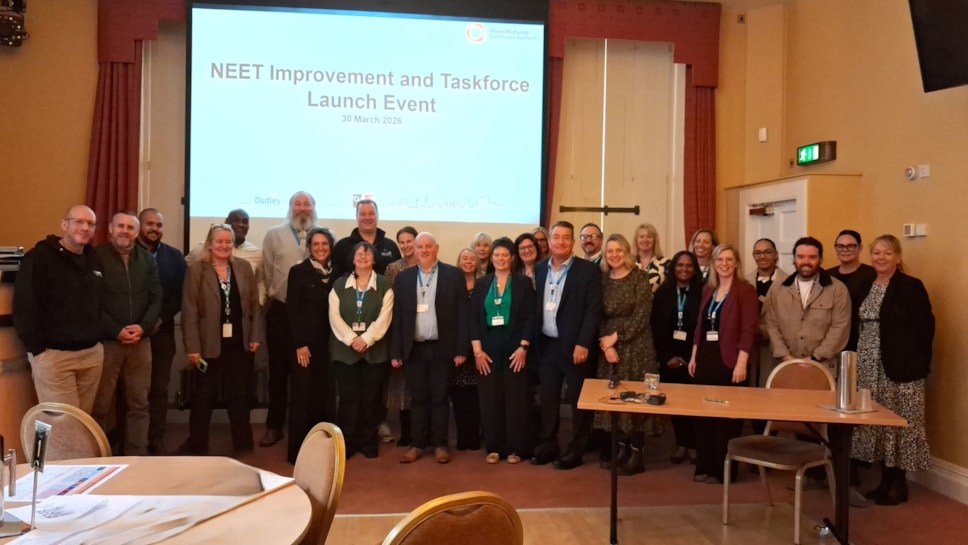
A stakeholder taskforce launched on 30 March 2026 brought together 35 representatives from organisations including Dudley College, Halesowen College, Sandwell College, Kidderminster College, the Department for Work and Pensions, the West Midlands Combined Authority and Dudley-based training providers.
A further multi-agency conference is planned for June, bringing together partners including private sector organisations to explore longer-term system improvements and co-design a borough-wide action plan.
The initiative supports Dudley Borough Council’s ambition to create a Child Friendly Borough where young people can thrive and compete for opportunities in a wider and increasingly competitive economy.
Anne Boyd, director for growth and infrastructure at Dudley Borough Council, said:
“We recognised early on that the headline figures did not tell the full story. Too many young people were recorded as ‘Not Known’, which meant we did not have the clear picture needed to provide the right support.
“Through determined work across council teams and partners we have strengthened how we track and engage with young people, including direct outreach to hundreds of households.
“That work has significantly reduced the number of unknowns and given us a much clearer understanding of the real position. It shows Dudley is much closer to national levels than the earlier data suggested.
“There is still more to do, but this collaborative approach gives us a strong foundation to remove barriers and help more young people in Dudley build positive futures.”